| size | read | mmap |
|---|---|---|
| 4 MiB | 0.02 | 0.01 |
| 16 MiB | 0.01 | 0.04 |
| 64 MiB | 0.01 | 0.10 |
| 256 MiB | 0.06 | 0.54 |
| 1 GiB | 0.20 | 1.84 |
| 4 GiB | 3.77 | 7.72 |
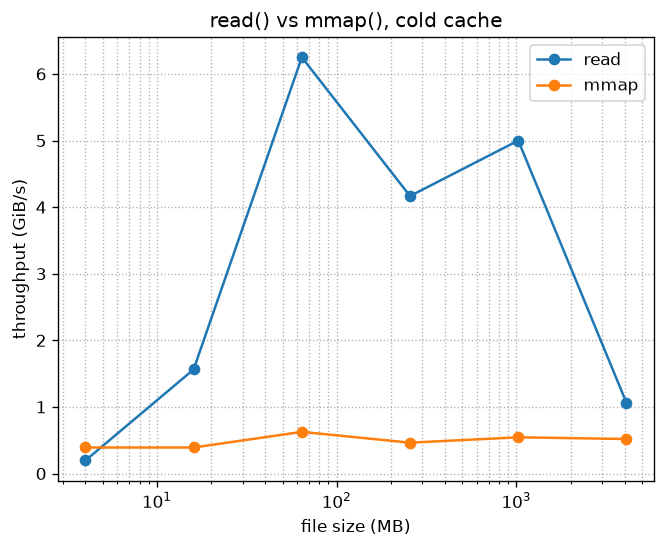
I am currently working on loading language models in a fast way.
In this context, I have been encountering the mmap system
call a lot. In this blog, I document how I went to understand
mmap in an experimental way.
mmap?We will ask this question to the man page of mmap using
the command man mmap:
#include <sys/mman.h>
void *mmap(
    void *addr,
    size_t len,
    int prot,
    int flags,
    int fd,
    off_t offset
);
The mmap() system call causes the pages starting at addr and continuing for at most len bytes to be mapped from the object described by fd, starting at byte offset offset.
First, we can deduce that mmap stands for “memory
mapping”. One immediate benefit we can see is that mmap
could be used to read from a file in the same way we read memory i.e by
going through virtual addresses1.
Let’s also look at somes values that flags can take:
MAP_ANON Map anonymous memory not associated with
any specific file. The offset argument is ignored.
MAP_FILE Mapped from a regular file. (This is the
default mapping type, and need not be specified.)
MAP_ANON essentialy is what enables using
mmap to map to main memory.
In mmap, the mapping happens in two steps:
1. Reserving a virtual memory region. Let’s
understand the first point. A process holds a list of virtual memory
regions. Each virtual memory region is described by a
struct vm_area_struct in the kernel4.
Reserving a virtual memory region means that the kernel will
create a new struct vm_area_struct and add it to the list
of virtual memory regions of the process. Let’s see this in
practice.
We will use mmap with addr set to
NULL, which means that the kernel will choose the address
for us. We will also use MAP_ANONYMOUS to indicate that we
want to map a portion of main memory, not a file. fd will
be set to -1 and offset to 0,
since we are not mapping a file. We will then print the contents of
/proc/self/maps which are the process’s virtual memory
addresses. We will do this before and after the mmap call
to see the difference.
#include <sys/mman.h>
#include <stdio.h>
#include <stdlib.h>
#include <unistd.h>

static void dump_maps(const char *label) {
    printf("\n--- /proc/self/maps (%s) ---\n", label);
    FILE *f = fopen("/proc/self/maps", "r");
    if (!f) { perror("fopen /proc/self/maps"); return; }
    char line[512];
    while (fgets(line, sizeof(line), f)) {
        fputs(line, stdout);
    }
    fclose(f);
    fflush(stdout);
}

int main(void) {
    dump_maps("before mmap");

    void *addr = mmap(NULL, 4096,
                      PROT_READ | PROT_WRITE,
                      MAP_PRIVATE | MAP_ANONYMOUS,
                      -1, 0);
    if (addr == MAP_FAILED) { perror("mmap"); return 1; }

    printf("\nMapped address: %p\n", addr);

    dump_maps("after mmap");
    return 0;
}
Source: mmap_basics.c
Output(better looked at on a laptop):
--- /proc/self/maps (before mmap) ---
00400000-00401000 r-xp 00000000 00:2e 8                                  /w/mmap_basics
0041f000-00420000 r--p 0000f000 00:2e 8                                  /w/mmap_basics
00420000-00421000 rw-p 00010000 00:2e 8                                  /w/mmap_basics
2a0b5000-2a0d6000 rw-p 00000000 00:00 0                                  [heap]
ffffb7700000-ffffb789c000 r-xp 00000000 00:3f 180862                     /usr/lib/aarch64-linux-gnu/libc.so.6
ffffb789c000-ffffb78ad000 ---p 0019c000 00:3f 180862                     /usr/lib/aarch64-linux-gnu/libc.so.6
ffffb78ad000-ffffb78b0000 r--p 0019d000 00:3f 180862                     /usr/lib/aarch64-linux-gnu/libc.so.6
ffffb78b0000-ffffb78b2000 rw-p 001a0000 00:3f 180862                     /usr/lib/aarch64-linux-gnu/libc.so.6
ffffb78b2000-ffffb78bf000 rw-p 00000000 00:00 0
ffffb78c1000-ffffb78e9000 r-xp 00000000 00:3f 180842                     /usr/lib/aarch64-linux-gnu/ld-linux-aarch64.so.1
ffffb78f1000-ffffb78f3000 rw-p 00000000 00:00 0
ffffb78fa000-ffffb78fc000 rw-p 00000000 00:00 0
ffffb78fc000-ffffb78fe000 r--p 00000000 00:00 0                          [vvar]
ffffb78fe000-ffffb78ff000 r-xp 00000000 00:00 0                          [vdso]
ffffb78ff000-ffffb7901000 r--p 0002e000 00:3f 180842                     /usr/lib/aarch64-linux-gnu/ld-linux-aarch64.so.1
ffffb7901000-ffffb7902000 rw-p 00030000 00:3f 180842                     /usr/lib/aarch64-linux-gnu/ld-linux-aarch64.so.1
ffffb7902000-ffffb7903000 rw-p 00000000 00:00 0
ffffca2b8000-ffffca2d9000 rw-p 00000000 00:00 0                          [stack]

Mapped address: 0xffffb78f9000

--- /proc/self/maps (after mmap) ---
00400000-00401000 r-xp 00000000 00:2e 8                                  /w/mmap_basics
0041f000-00420000 r--p 0000f000 00:2e 8                                  /w/mmap_basics
00420000-00421000 rw-p 00010000 00:2e 8                                  /w/mmap_basics
2a0b5000-2a0d6000 rw-p 00000000 00:00 0                                  [heap]
ffffb7700000-ffffb789c000 r-xp 00000000 00:3f 180862                     /usr/lib/aarch64-linux-gnu/libc.so.6
ffffb789c000-ffffb78ad000 ---p 0019c000 00:3f 180862                     /usr/lib/aarch64-linux-gnu/libc.so.6
ffffb78ad000-ffffb78b0000 r--p 0019d000 00:3f 180862                     /usr/lib/aarch64-linux-gnu/libc.so.6
ffffb78b0000-ffffb78b2000 rw-p 001a0000 00:3f 180862                     /usr/lib/aarch64-linux-gnu/libc.so.6
ffffb78b2000-ffffb78bf000 rw-p 00000000 00:00 0
ffffb78c1000-ffffb78e9000 r-xp 00000000 00:3f 180842                     /usr/lib/aarch64-linux-gnu/ld-linux-aarch64.so.1
ffffb78f1000-ffffb78f3000 rw-p 00000000 00:00 0
ffffb78f9000-ffffb78fc000 rw-p 00000000 00:00 0
ffffb78fc000-ffffb78fe000 r--p 00000000 00:00 0                          [vvar]
ffffb78fe000-ffffb78ff000 r-xp 00000000 00:00 0                          [vdso]
ffffb78ff000-ffffb7901000 r--p 0002e000 00:3f 180842                     /usr/lib/aarch64-linux-gnu/ld-linux-aarch64.so.1
ffffb7901000-ffffb7902000 rw-p 00030000 00:3f 180842                     /usr/lib/aarch64-linux-gnu/ld-linux-aarch64.so.1
ffffb7902000-ffffb7903000 rw-p 00000000 00:00 0
ffffca2b8000-ffffca2d9000 rw-p 00000000 00:00 0                          [stack]
First, we can get a sense of what kind of information the kernel
keeps of the processes’ memory regions. We can see that our program
mmap_basics has is stored in the virtual memory region
00400000-00421000. The heap is stored in the virtual memory
region 2a0b5000-2a0d6000. The stack is stored in the
virtual memory region ffffca2b8000-ffffca2d9000.
Answering our question: We can see that mmap gives us an
address 0xffffb78f9000 and when we look at the
/proc/self/maps output, we can see that this address range
is present in the process’s virtual address space
ffffb78f9000-ffffb78fc000 rw-p 00000000 00:00.
Conclusion: mmap reserves a virtual memory region
for the process by adding a new struct vm_area_struct to
the list of virtual memory regions of the process.
2. Lazy memory mmaping. One really important thing to note is that the mmaping to a physical page happens lazily. That is until the process actually accesses the memory at that address, the kernel will not allocate a physical page for it. Let’s see this in practice.
To show this, we can watch two fields from
/proc/self/status:
VmSize: total virtual address space of
the process.VmRSS: resident set size, i.e. the
physical memory currently backing the process.The plan is:
mmap a large anonymous region (256 MiB).VmSize and VmRSS.VmSize and VmRSS again.The full program is in lazy_alloc.c. The interesting part is:
const size_t N = (size_t)256 * 1024 * 1024;  // 256 MiB

print_status("before mmap");

char *p = mmap(NULL, N, PROT_READ | PROT_WRITE,
               MAP_PRIVATE | MAP_ANONYMOUS, -1, 0);

print_status("after mmap, before touch");

for (size_t i = 0; i < N; i += 4096) {
    p[i] = 1;   // touch every page
}

print_status("after touching every page");
Running it:
[before mmap]
VmSize:     2136 kB   (virtual memory for this process)
VmRSS:       692 kB   (physical memory for this process)

mmap'd 256 MiB at 0xffff85a00000

[after mmap, before touch]
VmSize:   264412 kB   (virtual memory for this process)
VmRSS:     1108 kB   (physical memory for this process)

[after touching every page]
VmSize:   264412 kB   (virtual memory for this process)
VmRSS:   263344 kB   (physical memory for this process)
Reading this:
mmap, VmSize jumps by ~256 MiB
immediately — the kernel reserved 256 MiB of virtual
address space. But VmRSS barely moves, because no physical
pages have been allocated yet. The mapping exists only as bookkeeping in
the kernel’s VMA table.VmRSS jumps by ~256 MiB.
Each write triggered a page fault5; the kernel handled it
by allocating a physical page and mapping it into the process’s page
table6. Only now does the mapping consume
actual RAM.This is why on Linux you can mmap an amount of memory
that is much larger than the system’s physical RAM: as long as you never
touch most of it, it costs nothing in physical memory. This is what
malloc uses when it needs to allocate a large chunk of
memory: it mmaps it, and only when the program actually
uses it does the kernel allocate physical pages.
Conclusion: mmap reserves a virtual memory region
for the process, but the mapping to physical pages happens lazily, only
when the process accesses the memory.
We mentioned earlier that malloc uses mmap
under the hood for large allocations. Let’s see how this works in
practice. We can watch this happen with strace. Our program
does one small malloc(1 KiB), one large
malloc(1 MiB), and then frees both, printing markers to
stderr between each step so they interleave with the syscall trace:
mark("small malloc (1 KiB)"); // just for printing
void *small = malloc(1024);

mark("large malloc (1 MiB)");
void *large = malloc(1024 * 1024);

mark("free small");
free(small);

mark("free large");
free(large);

mark("done");
Source: malloc_strace.c
Let’s run it under strace to see what syscalls are
made:
strace -e trace=brk,mmap,munmap ./malloc_straceThe relevant tail of the output:
--- small malloc (1 KiB) ---
brk(NULL)              = 0x18281000        # query current program break
brk(0x182a2000)        = 0x182a2000        # grow heap by 132 KiB
--- large malloc (1 MiB) ---
mmap(NULL, 1052672, PROT_READ|PROT_WRITE,
     MAP_PRIVATE|MAP_ANONYMOUS, -1, 0) = 0xffffb6b4f000
--- free small ---
                                            # no syscall
--- free large ---
munmap(0xffffb6b4f000, 1052672) = 0
Full trace: malloc_strace.out
A few things to notice:
malloc triggered brk, not
mmap. glibc grew the heap by 132 KiB (much more than the 1
KiB requested) so future small allocations can be served without another
syscall.malloc used mmap for a fresh
anonymous region. The requested size is 1 MiB + 4 KiB
because glibc reserves one extra page for its chunk header.Why the split? It comes down to the fact that the
heap is a single contiguous region whose size is
controlled by one number: the program break. brk can only
move that break up or down, so the only memory you can ever return to
the kernel from the heap is the memory at the very top of it. Anything
trapped underneath a still-live allocation is stuck.
Imagine allocating a 100 MiB buffer inside the heap and then freeing it while a tiny 8-byte allocation sits above it:
     heap grows this way ─────────►
   ┌──────────────┬────────────────────────┬──────┬───────┐
   │ small allocs │  100 MiB (freed)       │ 8 B  │ ...   │  program break ─►
   └──────────────┴────────────────────────┴──────┴───────┘
                            ▲
                            └── cannot be returned to the OS:
                                the 8 B chunk above it pins the break.
Even though the 100 MiB is unused, glibc cannot call brk
to shrink the heap because that would also invalidate the 8-byte chunk
sitting above it. The freed memory just stays in a free list, wasting
RSS. mmap regions don’t have this problem, each one is an
independent VMA: So by routing large allocations
through mmap, glibc guarantees that a single big
free() actually gives the memory back to the kernel.
Conclusion: malloc uses mmap for large
allocations because it allows the kernel to reclaim memory immediately
when the allocation is freed, whereas small allocations are served from
the heap and cannot be returned to the kernel until the program break is
moved down.
First, let’s see first what happens when we use read()
to access a file. We will use strace to trace the system
calls made by our program. We will then compare the system calls made
when we use mmap to access a file.
Here’s the code we will use to access a file using
read() and mmap():
#define FILE_SIZE (16 * 16384)

int main(int argc, char *argv[]) {
    if (argc != 3) {
        fprintf(stderr, "usage: %s <read|mmap> <file>\n", argv[0]);
        return 1;
    }

    int fd = open(argv[2], O_RDONLY);
    if (fd < 0) { perror("open"); return 1; }

    long pgsz = sysconf(_SC_PAGESIZE);

    print_faults("before");

    volatile char sink = 0;

    if (strcmp(argv[1], "read") == 0) {
        static char buf[FILE_SIZE];
        ssize_t n = read(fd, buf, FILE_SIZE);
        if (n > 0) sink ^= buf[0];
    } else {
        char *p = mmap(NULL, FILE_SIZE, PROT_READ, MAP_PRIVATE, fd, 0);
        for (size_t i = 0; i < FILE_SIZE; i += pgsz)
            sink ^= p[i];
        munmap(p, FILE_SIZE);
    }

    (void)sink;
    print_faults("after");
    close(fd);
    return 0;
}
Source: mmap_file.c
Here are the strace commands we will use to trace the
system calls made by our program:
dd if=/dev/urandom of=testfile.bin bs=16384 count=16 status=none
sudo purge # clear the page cache
./mmap_file mmap testfile.bin | tee results_mmap.txt
We show the results after the
openat(..., "testfile.bin", ..) system call.
openat(AT_FDCWD, "testfile.bin", O_RDONLY) = 3
read(3, "\260\273\250|;\363\363\350\353G\177\253\2624Y\334\257\353\4n\1772*\320\226\24x\360\264\315\223\377"..., 262144) = 262144
Full trace: strace_read.txt
We have 1 read() system call that reads the entire file
into the page cache7. The kernel will then map the page
cache to our virtual memory.
Let’s now see the results when we use mmap() to access
the file:
openat(AT_FDCWD, "testfile.bin", O_RDONLY) = 3
mmap(NULL, 262144, PROT_READ, MAP_PRIVATE, 3, 0) = 0xffffa6af0000
munmap(0xffffa6af0000, 262144)          = 0
Full trace: strace_mmap.txt
We have the mmap() system call that maps the file into
our virtual memory and the munmap() system call that unmaps
the file from our virtual memory. But we do not have a system call for
reading the file into the page cache. This is because the kernel will
read the file into the page cache when a page fault
occurs.
To check that, we will print the number of page faults before and
after accessing the file. We will use the getrusage()
system call to get the number of page faults8. I
run this experiment on my mac and I get the following results:
read:
[before] majflt=37
[after] majflt=37mmap:
[before] majflt=114
[after] majflt=130
We can see, that we have 16 major page faults when we use
mmap() to access the file. One per page fault.
Note: This experiment was run macOS, as opposed to Linux through
docker like the previous experiments. With the docker setup, I was only
seing one 1 major page fault when using mmap() to access
the file. I am not sure why this is the case.
Conclusion: When we read a mmaped file through
virtual memory, either that address is mapped to a page in the page
cache or it will trigger a page fault and the kernel will read the file
into the page cache.
mmap for large sequential reads compared to
read()?We measured both approaches on files of increasing size on macOS. For
each size, we open the file, walk through it once (one byte per page for
mmap, 1 MiB chunks for read) and record the
wall time. The full benchmark is in mmap_file_bench.c.
Results (seconds):
| size | read | mmap |
|---|---|---|
| 4 MiB | 0.02 | 0.01 |
| 16 MiB | 0.01 | 0.04 |
| 64 MiB | 0.01 | 0.10 |
| 256 MiB | 0.06 | 0.54 |
| 1 GiB | 0.20 | 1.84 |
| 4 GiB | 3.77 | 7.72 |
read() wins clearly as soon as the file is more than a
few MiB. The reason is that mmap pays one page fault per 4
KiB page: each fault traps into the kernel, allocates a page in the page
cache, and updates the process page table. For a 1 GiB file that is
262144 faults, all on the critical path. read() on the
other hand asks the kernel to copy a large chunk in a single syscall,
which lets the kernel issue big sequential I/Os and amortize the
per-call overhead.
Conclusion: for a large sequential scan, read() is
faster than mmap().
We saw what mmap does and how it works. We also
investigated how malloc uses mmap for large
allocations and how mmap can be used to access files. We
benchmarked mmap and read() for large
sequential reads and found that read() is faster than
mmap() for large files. The reason, as our last experiment
showed, is that mmap pays one page fault per page while
read() can copy a large chunk in a single syscall.
virtual memory: an abstraction of the memory resources that are available to a process. Each process can access its own virtual address space, without worrying about the physical memory of the machine.↩︎
process: a program in execution. Isolated from other processes. In particular, each process has its own virtual address space.↩︎
page: a fixed-size block of contiguous memory.↩︎
kernel: the part of an OS that manages the system’s important resources (the CPU, memory, and I/O devices).↩︎
page fault: occurs when a process accesses a virtual address whose page is not currently mapped in its page table.↩︎
page table: a table that maps virtual addresses to physical addresses.↩︎
page cache: a cache of pages in memory that have been read from disk.↩︎
major/minor page fault: a major page fault occurs when the kernel has to read the page from disk to satisfy the access. A minor page fault occurs when the page is already in RAM (e.g. in the page cache) but not yet wired into the process’s page table, so the kernel can satisfy the request without going to disk.↩︎